Wednesday, August 5, 2009

Denbow 1
Whitney Denbow
College Writing II
Prof. Clewell
August 5, 2009

The Electric Kool-Aid Acid Experience: Cultural Effects of LSD
In a decade filled with more notable passion, rebellion, and disillusionment than any other, the 1960’s was an exploratory time period. With the Vietnam War in its prime, youth culture and rebellion developed into a mainstream lifestyle. Countercultures were arising and allegiance to the ideals of the Beat Generation were transitioning into something vastly different. Jack Kerouac, a beat generation author, envisioned a lifestyle free of the scrutenies of the mainstream. John Leland, author of Why Kerouac Matters, writes about the youth who attended Kerouac’s funeral. He explains,
Visionary drugs, music as group sacrament, the nonviolent witness to the holiness of all
sentient life -- all this had surfaced as he knew it would, and, far from being derided in the
media or patronized by the Academy, it was being heralded as the unique culture of a New
Age. (181)
The youth of the sixties were beginning to live out the envisioned lifestyle Kerouac once dreamed of. In the forefront of all the progression was accelerating interest in psychedelics and psychoactive drugs. The newest and most predominant was LSD. Ken Kesey, not only a charismatic man, but remarkably intelligent, lead one of the first LSD movements. The initial appeal towards the drug was minimal at best, but with the help of Kesey, acid use became a subculture all it’s own. The ideas of mind alteration, limitless creativity, shifting away from
mainstream culture, and the creation of freedom within the body drove the youth of the sixties, beginning with the Merry Pranksters, to experiment with LSD.

The Beat Generation was slowly dying down and a need for new, more expansive movement was arising. The mood throughout the country was chaotic and rebellious due to the controversial war at hand. According to Robert Stone, author of Prime Green: Remembering the Sixties, “...it was good to be alive and to be young was even better. More than the inhabitants of any other decade before us, we believed ourselves in a time of our own making” (95). The youth of the nation were coming into their own as a commanding generation, looking to prove a point, make a stance, be heard. “They’re just beginning to open the doors in their minds” (124), says Gary Goldhill in Tom Wolfe’s text The Electric Kool-Aid Acid Test. The precursor to the hippy generation, calling themselves the Merry Pranksters, was on the rise. They were looking for anyone and everyone to not only open their minds, but take their minds to places never gone before. Kesey was ready to lead his pranksters on an LSD-enduced crusade around the country. Touring on a paint-covered bus entitled Further, the pranksters took on a new consciousness through the use of LSD with the goal of remaking America as a nation on acid.

One attractive quality of LSD was its ability to create a feeling of indifference and positivity. The Beat Generation rebelled against the mainstream American values and LSD was an escape from that negative reality. In Peter O. Whitmer’s novel Aquarius Revisited, Allen Ginsberg, a beat writer who later experimented with LSD for a short time, is quoted saying,
I thought that if everyone in America had it, it would build up some kind of critical mass and
open up a lot of seriousness and sublimity and spirituality; the realization that the whole
hard-edge, negative psychology of business, war, competition, and suspiciousness would
melt. There would be a different attitude toward people, and different attitudes toward society
and different attitudes toward being alive. It would be much more open...a sense of
wide-open, nonjudgmental, nonprejudicial inquisitiveness. (207)
Ginsberg felt that, if truly spread throughout the nation, the effects of LSD could give people a chance to open their minds to more important issues. It would cause people to realize that negativity and prejudices are infantile in the whole scheme of things. America was in need of a positive make-over and LSD seemed to be the answer. As Kesey and the pranksters toured throughout the United States, they stopped to hold ‘acid tests’ along the way. According to Whitmer,
Kesey’s Trips Festivals had begun in Santa Cruz in 1965 and evolved into mass celebrations, gathering places where cauldrons of Kool-Aid were labeled Electric if laced with LSD. Few, if
any, knew whether the signs had been switched, or if perhaps both vats were laced, or
neither. Fewer still cared; most people showed up already laced. Nor were many sure what
was being celebrated, other than life itself. These were pagan rites, with hundreds of people
experiencing the same drugs, the same strobe lights, and the same music. (184)
This ability to break away from the turmoils and troubles of everyday life and have a sense of overall happiness was extremely appealing. The ‘trip’ was enough to keep the celebration of “life itself” going.

Along with overall peace of mind, acid established a heightened sense of creativity and imaginativeness. A prominent figure throughout the acid test movement was Jerry Garcia, lead guitarist and vocalist for the rock band The Grateful Dead. Garcia joined the pranksters on their acid-test bus tour, finding music inspiration anywhere he could. In an interview, Dennis McNally, a past deadhead and author of a 600-page Grateful Dead biography, stated,
What it did for them most remarkably and most importantly -- in the Acid Test period,
which, by the way, was two months -- was redirect their notion of what they were up to, and
it made them understand that the audience was not separate from them, but was part of their experience, that they were partners. And that, in fact, the Grateful Dead was not six guys on stage, but everybody in the room and the instruments and the sound system.
McNally is saying that LSD may not have been used continually during the Dead’s entire music career, but their initial use caused remarkable effects. Not only did acid spark new creativity throughout their music, but formed a strong bond and following with their fans. Creativity through acid-enduced music wasn’t strictly on the professional level. While tripping, the pranksters found a new form of expression through singing, coherent or not. Wolfe explains, “Kesey and the Pranksters and the [Hells] Angels had taken to going out to the backhouse and sitting in a big circle and doing the Prankster thing, a lot of rapping back and forth and singing, high on grass, and you never knew where it was going to go” (97). Many of the pranksters found that playing musical instruments took to much effort while tripping, but the ‘rapping,’ making incoherent noises, and singing obscurely, boosted their high.

Although bad acid trips did occur, to the pranksters the pros of LSD use outweighed the cons. Few pranksters encountered a bad trip, but when they did, they were completely alone. Wolfe describes one man’s paranoid trip:
...Sandy felt paranoid...what do they really think of him? What are they planning? What
insidious prank? He can’t get it out of his mind that they are building up some prank of
enormous proportions, at his expense. A Monstrous Prank ... He can’t sleep, his brain keeps
going at the furious speed of the bus on the road like an eternal trip on speed. (63)
Though Sandy eventually leaves the pranksters for psychiatric help, bad trips like his didn’t frighten the others. Ken Kesey had a calming presence that kept the others believing that their were excuses for bad trips. In The Electric Kool-Aid Acid Test, Wolfe writes,
‘There are going to be times,’ says Kesey, ‘when we can’t wait for somebody. Now, you’re
either on the bus or off the bus. If you’re on the bus, and you get left behind, then you’ll find it again. If you’re off the bud in the first place -- then it won’t make a damn.’ And nobody had
to have it spelled out for them. Everything was becoming allegorical, understood by the
group mind, and especially this: ‘You’re either on the bus ... or off the bus’. (46)
Kesey explains that either your mind is where it should be, ‘on the bus,’ or it is not yet ready for their psychedelic experience. It seems as though Sandy wasn’t on the bus anymore. Sandy wasn’t up to snuff and it was no fault of the drug, merely a fault of his unwillingness to open his mind. Once Sandy was willing to find his way back to the bus, his LSD experience would be positive once more.

Tripping wasn’t about the hallucinations and breaks from reality, it was about the experience. Attempting to explain the exact effects of LSD wasn’t necessary to the pranksters. Wolfe explains, “The whole thing was ... the experience ... this certain indescribable feeling .. Indescribable, because words can only jog the memory, and if there is no memory of ... The experience of the barrier between the subjective and the objective, the personal and the impersonal” (25-26). Feeling, sensing, experiencing was the goal at hand. To the pranksters, the acid-trip movement was a way of life, something that was supposed to be shared with everyone. No one person should be left behind. The hard part about gaining more members, was the persuasion to try something new and misunderstood. Kesey didn’t want to explain what LSD did and how it effected the body, he wanted everyone to let the experience speak for itself. He believed that once everyone had felt life through the eyes of LSD, there was no way they would ever want to live any other way. “...It grows out of the experience, with LSD. The whole other world that LSD opened your mind to existed only in the moment itself -- Now -- the moment, back in the world of conditioning and training where the brain was a reducing valve..” (33), says Wolfe about the prankster’s views on LSD. The only way to truly understand and see the new world of LSD, was through the experience of an acid trip, supplied by Ken Kesey.

Ken Kesey and the Merry Pranksters generated the psychedelic movement of the 1960’s. During a time of disillusionment and defiance among youth culture, LSD became a prominent outlet for many. It was a release for inner creativity and imagination, along with a new perspective on life. Kesey led a modest group of the youth on an acid expedition, shifting them
away from the mainstream and altering their minds to deeper levels than ever thought possible. The goal in mind was to gain recognition, not through demand or force, but simply experience. The pranksters believed everyone could benefit from the LSD experience. This campaign kicked off an entire counterculture throughout the United States, becoming a forerunner for the hippy movement. New musical genres were created, new positive perceptions of life were exhibited and an overall new perception of the drug culture was established.


Works Cited

Cruickshank, Douglas. “The life of the Dead.” Salon.com. 2 Aug. 2009.


Leland, John. Why Kerouac Matters. New York: Penguin Group Inc, 2007.

Stone, Robert. Prime Green: Remembering the Sixties. New York: HarperCollins Publishers, 2007.

Whitmer, Peter O. Aquarius Revisited. New York: Macmillan Publishing Company, 1987.

Wolfe, Tom. The Electric Kool-Aid Acid Test. New York: World Journal Tribune Corporation, 1968.

Wednesday, July 29, 2009

Nightmares by Day. Day-glo by Night.


LCD. Acid. Feeling. Flowing. Seeing color. The experience that is the acid test. Ken Kesey and the Merry Pranksters portray the image of freedom of thought and expression. The pranksters take on a new consciousness through the use of LCD with the goal of remaking America as a nation on acid. Tom Wolfe's The Electric Kool-Aid Acid Test tells this trippy tale.

Riding around on a paint-covered bus, blaring music, rapping noises, tripping on acid, covered in day-glo and welcoming anyone who will listen, the pranksters are on the ultimate 'trip.' Ken Kesey leads the gang with the goal of gathering the nation into an LCD-enduced existance. Tom Wolfe, the author and narrator, depicts Kesey and the pranksters' short-lived endeavor. With LCD being legal due to the fact it was such a new phenomenon, the pranksters hold many 'acid tests,' inviting anyone who will come and discover the drug's effects.

This movement, though a failure, was one of the most unique attempts to alter our nation's entire metality, spirituality, and concept altogether. What would have come of America if this campaign had caught on? Would it have changed history altogether? Its strange thing to think about. The entire mind-set on drug culture and psychadelics could be flip-flopped. Government ideals would be different, school criteria would change, social gatherings would be completely offbeat. Life in the United States would be turned upside down.

Thankfully, every man, woman, and child is not chronically trippy on acid. Hallucinations aren't seen on a daily basis and our buildings aren't covered in neon paintings and day-glo splatters. Random gargled vocals aren't blared out through loudspeakers on every street corners and there aren't a million new flavors of kool-aid to spike. The time of the Merry Pranksters has come and gone, but with their movement came the hippies. The hippies shone a new light on the perception and knowledge we now have for the drug culture. Drugs will probably never be a thing of the past but as for now, sobriety seems to be the most popular trend.

Thursday, July 16, 2009

Carlo Marx is on the Road


Allen Ginsberg's HOWL and Jack Kerouac's On The Road were written during the beat generation of the 1950's. Even though HOWL is written as a stream of consciousness poem and On the Road is novel form, the two pieces have a lot in common. Kerouac even personifies Ginsberg in On The Road as the character Carlo Marx. The theme of 'movement', along with a pregression from raw emotion to a deeper passionate sense of being, are found in both writings.

Both Kerouac and Ginsberg provide a sense of movement, motion, and evolution. Sal Paradise, of On The Road, is moving physically while Ginsberg is moving the reader figuratively. In HOWL, according to Shmoop.com, the reader moves through "places where people are struggling to make ends meet: Paradise Alley, the Bowery, Staten Island, the Bronx, Harlem. We travel through dive bars and diners, cramped apartments and cemeteries." There are subway rides, landmarks like the Empire State Building and the Brooklyn Bridge, and in public parks late at night. "When life gets too crazy, we skip town and head for New Jersey." The consistancy of movement throughout HOWL is always solid while Sal's journeys from east to west is constantly shifting. Sal never seems to take a break. Once he is on the road, whether it's Mahattan, Chicago, Cheyenne, Denver, San Francisco, or even Mexico, there is never any stagnant time. Sal can never decide whether to stay out west or head home back east.

In the beginning of HOWL, the mood is dark, angry and almost unpleasant. Ginsberg first line states; "I saw the best minds of my generation destroyed by madness, starving hysterical, naked." He continues for over fifty lines explaining this feeling. Ginberg's true self comes out through the poem, expressing his homosexuality and anger towards "the man." He even comes to say "...who balled in the morning in the evenings in the rose-gardens and the grass of public parks and cemeteries scattering their semen freely to whomever come who may." There is a sense of anguish and sadness within the anger. This sadness is extremely relatable to Sal Paradise's character as well. On The Road begins with Sal feeling lost and desiring to experience new and exciting things. Opportunity comes knocking when Sal meets Dean Mortiarty. Dean may have had a dark past, but he is a free spirit and paves the way for Sal to leave behind his sad life and live on the road. Sal is extremely negative about himself initially and the only happiness he finds is when he picks up and moves.

Both pieces of writing end on a totally different note than they began. Ginsberg ends his poem in part III where he is in Rockland psychiatric hospital speaking to Carl Solomon. He begins each line with "I'm with you in Rockland" and in the last lines says; "I'm with you in Rockland in my dreams you walk dripping from a sea-journey on the highway across America in tears to the door of my cottage in the Western night." His new optimism and positive attitude ends the poem in high spirits. Kerouac ends On The Road on the same optimistic note. Sal is in a new place and is able to reflect upon all that happened with him and Dean throughout the years. He reflects on the “raw land”, of “people dreaming”, of children crying, and compares God to Pooh Bear. He says that “complete night blesses the earth” and that “nobody knows what’s going to happen to anybody besides the forlorn rags of growing old.”

Both men may not find peace or closure to their personal inner or outer struggles, but they find comfort. Comfort in knowing that there is still a future, there is still more to be lived and learned. Comfort in the unknown, in their dreams, in their aspirations, in their past experiences. The beat generation rejected the mainstream culture and this literature carved the way for other beatniks and future generations to understand and relate to their circumstances.


http://www.shmoop.com/intro/poetry/allen-ginsberg/howl.html

Tuesday, June 30, 2009

Why Catcher is so Catchy

Why is J.D. Salinger's The Catcher in the Rye still so relevant to teens half a century after publication? Throughout their academic careers, most young adults have come in contact with the controversial novel. How is this particular piece of literature so gripping that it can be analyzed and studied decades after being written? Understanding why the story is still picked-apart, debated over and studied will affirm it's prominence in American literature and youth culture. The relevancy of this novel is still very much alive today.

The historical background of the novel sets base to its success. "Two J.D. Salinger short stories, I'm Crazy and Slight Rebellion off Madison, were published in periodicals during the 1940's, and introduced Holden Caulfield, the main character of The Catcher in the Rye." Salinger incorporated the short stories into his novel, adding teenage grammar and slang of the 1950's. Catcher became "the most censored, banned and challenged book between 1966 and 1975." A book with such a reputation is bound to attract some attention. Written during the time of the Civil Rights Movement and Anti-Vietnam War Movement, the novel became a crusade of its own. The emergence of teen rebellion and youth culture was in its prime. Teens looked to the novel as a voice for their own personal rebellions. The perspective of the controversial novel looked strictly to a young teenage mind to drive the story.

Salinger's decision to put Holden in control of every thought and emotion forced the book to become solely character-driven. The twist comes when Holden's perspective turns out to be openly debatable. The hypocritical and cynical boy is caught in the fall from adolescence into the adult world. When a character in such a situation has the freedom to say only what they please, much of the story is left up to the imagination of the reader. This phenomenon intrigues younger readers and gives the story a new spin when read for the second time. Salinger has the ability to leave questions unanswered and incorporate interpretive symbolism. The red hunting hat that Holden purchases is symbolic and can be interpreted in a variety of ways. Whether the hat symbolizes his insecurities, his uniqueness and individuality, or "mirrors the central conflict" he feels, is up for interpretation. All of these plausible interpretations are ones almost every teen encounters durning their adolescence. The Catcher in the Rye is a confusing title which helps attract its audience. Holden mistakenly hears the lyrics "when a body meets a body" for "when a body catches a body" in Robert Burns' song Comin' Thro' the Rye. This mistake gives the book its title and plays a crucial role in the story's greater meaning. With no true definitive answers to the symbolism, getting a grasp on the story deserves discussion. It's easy to understand why teachers and professors find the novel to be a worthwhile read for their maturing students. The desire to learn more about this disputable novel may have lead to its initial popularity with young adults.

The bulk of hype originally surrounding The Catcher in the Rye came from its many published reviews. Critics have praised and criticized the novel since its publication in 1951. Alfred Kazin's review states; "Salinger's vast public, I am convinced, is based merely on the number of young people who recognize their emotional problems in his fiction and their frustrated rebellions in the sophisticated language he manipulates so skillfully." Many reviewers agree with Kazin's view that the book is masterfully done and relatable to most teenagers. Other critics state that Holden is not only negatively repetitive, but he is a detraction for many readers. Holden's self-centered nature potentially obstructs the ability to establish any other characters on a deeper level. Besides his younger sister Phoebe, no other character is around long enough to significantly develop. Because Catcher is written in first person, the question of whether Holden is an over-developed character is frequently brought to the table. Holden may be over-developed in a sense, but he is such a complex person that it absolutely necessary for the novel's success. Many teens can identify with that fact that the focus never strays from Holden's twisted mind and his inner thoughts. It is written to monologue what he is feeling at that exact moment in time. For a teen, it is easy to connect to the frivolousness of his thoughts. Whether the reviews are positive or negative, with such a compelling main character and so many debates surrounding his disposition, The Catcher in the Rye is a must-read for all teens.

Holden Caulfield is one of the most complex and debatable figures in English literature. His negativity and self-loathing pulls the reader deeper and deeper into his world. Dislike towards his personality makes for a completely different perception of the overall story. How can you get so frustrated with main character but still want him to succeed? The complexity of his angst lays out common ground for almost every teen to relate to his emotions. His narcissistic and all-about-me attitude relates a sense of immaturity and raises question of his integrity. The obscurity of his persona is unique in the sense that the ending of the book twists his story in a whole new way. Is Holden merely writing to tell his side of the story or is it all fabricated to make us empathize with him? Holden's complexity causes him to appear shallow on the surface. He is hypocritical and rude, rebellious and angry, but also simply young, naive, and confused. Is Holden a hero? That question cannot and will not ever have an answer. His story hits home to some, and to others is just intriguing. Every teen perceives the Holden in a different light, causing vastly different opinions, none of which are incorrect. Salinger's ability to leave the door open for debate contributes to the legacy of The Catcher in the Rye.

When it comes down to it, Catcher in the Rye is a sensation in itself. Whether young or old, reading it for the first time or the twentieth, something about the story is capturing. The significance the actual book had on the emergence of the teen rebellion era cannot be measured. Speculation and controversy may have initially sparked interest but not many stories can detain relevancy half a century after being written. The story still holds true inside every teen searching for their true identity. This is an anomaly that will live on forever in its pages.

Sunday, June 21, 2009

Rebel Without a Cause


The transition from childhood into full-fledged teenager is a scary yet exciting phenomenon. Both males and females have fascinating new concerns and insights that, previously, were never an issue. A new, and predominately four-lettered, vocabulary. Dating. Hair in peculiar new places. Is that a pimple? But beside the obvious physical changes, that we so lovingly call puberty, the defining qualities of who teenagers are and how they came to be has a deeper history.


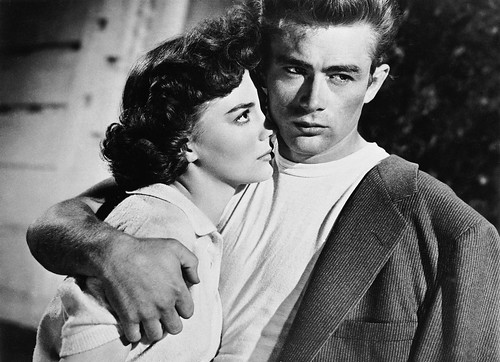
Prior to the 1950's and 60's, young adults weren't categorized in the way they are today. Youth culture and rebellion lead to a desire for young adults to emerge and define themselves in a new way. Jim Stark, better known as James Dean from Nicholas Ray's Rebel Without a Cause (1955), is a significant figure in the emergence of the "teenager." Dean's portrayal of Jim was not only a defining moment in the evolution of the teenager, but even today's youth culture can identify with his character. In the film, Jim is striving to find himself and where he belongs, much like most teenagers find themselves doing at some point during their adolescence. He struggles to find common ground with his parents, a common theme in many people lives, most predominately as teens and young adults. His style became a trend, whether it was his white t-shirt and jacket, smoking cigarettes, or a voluminous hairstyle, his look became a staple for other teens of his time, much like many young celebrities do for us today.


Growing up isn't always easy, it calls for many awkward stages, heartache, rumors and gossip, but the teenage years can be some of the best times of anyone's life. We are lucky enough today to live in a world where teens are able to express themselves, whether it be through music, art, clothing, tattoos and piercings, or just personal style. Hopefully we can look back on the first stand-out figures of teen rebellion and thank them for opeing the door for teens to be identified as a group who is still maturing and not stuck in a mold of who they are and what they must become. The sky is the limit.