Wednesday, July 29, 2009

Nightmares by Day. Day-glo by Night.


LCD. Acid. Feeling. Flowing. Seeing color. The experience that is the acid test. Ken Kesey and the Merry Pranksters portray the image of freedom of thought and expression. The pranksters take on a new consciousness through the use of LCD with the goal of remaking America as a nation on acid. Tom Wolfe's The Electric Kool-Aid Acid Test tells this trippy tale.

Riding around on a paint-covered bus, blaring music, rapping noises, tripping on acid, covered in day-glo and welcoming anyone who will listen, the pranksters are on the ultimate 'trip.' Ken Kesey leads the gang with the goal of gathering the nation into an LCD-enduced existance. Tom Wolfe, the author and narrator, depicts Kesey and the pranksters' short-lived endeavor. With LCD being legal due to the fact it was such a new phenomenon, the pranksters hold many 'acid tests,' inviting anyone who will come and discover the drug's effects.

This movement, though a failure, was one of the most unique attempts to alter our nation's entire metality, spirituality, and concept altogether. What would have come of America if this campaign had caught on? Would it have changed history altogether? Its strange thing to think about. The entire mind-set on drug culture and psychadelics could be flip-flopped. Government ideals would be different, school criteria would change, social gatherings would be completely offbeat. Life in the United States would be turned upside down.

Thankfully, every man, woman, and child is not chronically trippy on acid. Hallucinations aren't seen on a daily basis and our buildings aren't covered in neon paintings and day-glo splatters. Random gargled vocals aren't blared out through loudspeakers on every street corners and there aren't a million new flavors of kool-aid to spike. The time of the Merry Pranksters has come and gone, but with their movement came the hippies. The hippies shone a new light on the perception and knowledge we now have for the drug culture. Drugs will probably never be a thing of the past but as for now, sobriety seems to be the most popular trend.

Thursday, July 16, 2009

Carlo Marx is on the Road


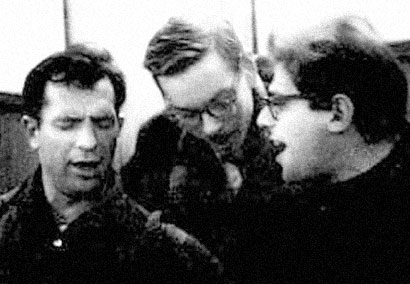
Allen Ginsberg's HOWL and Jack Kerouac's On The Road were written during the beat generation of the 1950's. Even though HOWL is written as a stream of consciousness poem and On the Road is novel form, the two pieces have a lot in common. Kerouac even personifies Ginsberg in On The Road as the character Carlo Marx. The theme of 'movement', along with a pregression from raw emotion to a deeper passionate sense of being, are found in both writings.

Both Kerouac and Ginsberg provide a sense of movement, motion, and evolution. Sal Paradise, of On The Road, is moving physically while Ginsberg is moving the reader figuratively. In HOWL, according to Shmoop.com, the reader moves through "places where people are struggling to make ends meet: Paradise Alley, the Bowery, Staten Island, the Bronx, Harlem. We travel through dive bars and diners, cramped apartments and cemeteries." There are subway rides, landmarks like the Empire State Building and the Brooklyn Bridge, and in public parks late at night. "When life gets too crazy, we skip town and head for New Jersey." The consistancy of movement throughout HOWL is always solid while Sal's journeys from east to west is constantly shifting. Sal never seems to take a break. Once he is on the road, whether it's Mahattan, Chicago, Cheyenne, Denver, San Francisco, or even Mexico, there is never any stagnant time. Sal can never decide whether to stay out west or head home back east.

In the beginning of HOWL, the mood is dark, angry and almost unpleasant. Ginsberg first line states; "I saw the best minds of my generation destroyed by madness, starving hysterical, naked." He continues for over fifty lines explaining this feeling. Ginberg's true self comes out through the poem, expressing his homosexuality and anger towards "the man." He even comes to say "...who balled in the morning in the evenings in the rose-gardens and the grass of public parks and cemeteries scattering their semen freely to whomever come who may." There is a sense of anguish and sadness within the anger. This sadness is extremely relatable to Sal Paradise's character as well. On The Road begins with Sal feeling lost and desiring to experience new and exciting things. Opportunity comes knocking when Sal meets Dean Mortiarty. Dean may have had a dark past, but he is a free spirit and paves the way for Sal to leave behind his sad life and live on the road. Sal is extremely negative about himself initially and the only happiness he finds is when he picks up and moves.

Both pieces of writing end on a totally different note than they began. Ginsberg ends his poem in part III where he is in Rockland psychiatric hospital speaking to Carl Solomon. He begins each line with "I'm with you in Rockland" and in the last lines says; "I'm with you in Rockland in my dreams you walk dripping from a sea-journey on the highway across America in tears to the door of my cottage in the Western night." His new optimism and positive attitude ends the poem in high spirits. Kerouac ends On The Road on the same optimistic note. Sal is in a new place and is able to reflect upon all that happened with him and Dean throughout the years. He reflects on the “raw land”, of “people dreaming”, of children crying, and compares God to Pooh Bear. He says that “complete night blesses the earth” and that “nobody knows what’s going to happen to anybody besides the forlorn rags of growing old.”

Both men may not find peace or closure to their personal inner or outer struggles, but they find comfort. Comfort in knowing that there is still a future, there is still more to be lived and learned. Comfort in the unknown, in their dreams, in their aspirations, in their past experiences. The beat generation rejected the mainstream culture and this literature carved the way for other beatniks and future generations to understand and relate to their circumstances.


http://www.shmoop.com/intro/poetry/allen-ginsberg/howl.html