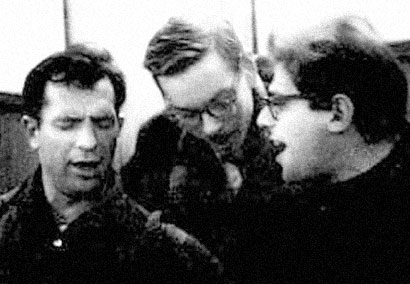
Allen Ginsberg's HOWL and Jack Kerouac's On The Road were written during the beat generation of the 1950's. Even though HOWL is written as a stream of consciousness poem and On the Road is novel form, the two pieces have a lot in common. Kerouac even personifies Ginsberg in On The Road as the character Carlo Marx. The theme of 'movement', along with a pregression from raw emotion to a deeper passionate sense of being, are found in both writings.
Both Kerouac and Ginsberg provide a sense of movement, motion, and evolution. Sal Paradise, of On The Road, is moving physically while Ginsberg is moving the reader figuratively. In HOWL, according to Shmoop.com, the reader moves through "places where people are struggling to make ends meet: Paradise Alley, the Bowery, Staten Island, the Bronx, Harlem. We travel through dive bars and diners, cramped apartments
 and cemeteries." There are subway rides, landmarks like the Empire State Building and the Brooklyn Bridge, and in public parks late at night. "When life gets too crazy, we skip town and head for New Jersey." The consistancy of movement throughout HOWL is always solid while Sal's journeys from east to west is constantly shifting. Sal never seems to take a break. Once he is on the road, whether it's Mahattan, Chicago, Cheyenne, Denver, San Francisco, or even Mexico, there is never any stagnant time. Sal can never decide whether to stay out west or head home back east.
In the beginning of HOWL, the mood is dark, angry and almost unpleasant. Ginsberg first line states; "I saw the best minds of my generation destroyed by madness, starving hysterical, naked." He continues for over fifty lines explaining this feeling. Ginberg's true self comes out through the poem, expressing his homosexuality and anger towards "the man." He even comes to say "...who balled in the morning in the evenings in the rose-gardens and the grass of public parks and cemeteries scattering their semen freely to whomever come who may." There is a sense of anguish and sadness within the anger. This sadness is extremely relatable to Sal Paradise's character as well. On The Road begins with Sal feeling lost and desiring to experience new and exciting things. Opportunity comes knocking when Sal meets Dean Mortiarty. Dean may have had a dark past, but he is a free spirit and paves the way for Sal to leave behind his sad life and live on the road. Sal is extremely negative about himself initially and the only happiness he finds is when he picks up and moves.

Both pieces of writing end on a totally different note than they began. Ginsberg ends his poem in part III where he is in Rockland psychiatric hospital speaking to Carl Solomon. He begins each line with "I'm with you in Rockland" and in the last lines says; "I'm with you in Rockland in my dreams you walk dripping from a sea-journey on the highway across America in tears to the door of my cottage in the Western night." His new optimism and positive attitude ends the poem in high spirits. Kerouac ends On The Road on the same optimistic note. Sal is in a new place and is able to reflect upon all that happened with him and Dean throughout the years. He reflects on the “raw land”, of “people dreaming”, of children crying, and compares God to Pooh Bear. He says that “complete night blesses the earth” and that “nobody knows what’s going to happen to anybody besides the forlorn rags of growing old.”
Both men may not find peace or closure to their personal inner or outer struggles, but they find comfort. Comfort in knowing that there is still a future, there is still more to be lived and learned. Comfort in the unknown, in their dreams, in their aspirations, in their past experiences. The beat generation rejected the mainstream culture and this literature carved the way for other beatniks and future generations to understand and relate to their circumstances.
http://www.shmoop.com/intro/poetry/allen-ginsberg/howl.html


I really like how you compared Howl and On the Road. I agree with you completely on the theme of "movement". I liked the way Howl started out, just as your explanied it, and how On the Road started out and continued. I do believe Sal felt lost yet when he found Dean it was like a whole new world was found. In the end Sal does reflect on everthing that happen, I do believe though that he saw Dean as his mentor, yet Sal was still looking for a father figure in Dean. The endings to both are totally different, but I like that, seeing that both of the writers were writing during the Beat movement, it would have been boring to have the same kind of ending. Good post!
ReplyDelete